














Re: Where Are All The Used Iso Tanks ?
Someone asked me the other day about the ISO Tank Containers periodic, maintenance/check, inspection operations that must be carried out on ISO Tank containers, every 2 and 1/2 year.
Answer courtesy of ITCO.
For portable tanks meeting the definition of "container" in the CSC, a prototype representing each design shall be subjected to an impact test. The prototype portable tank shall be shown to be capable of absorbing the forces resulting from an impact not less than 4 times (4 g) the MPGM of the fully filled portable tank at a duration typical of the mechanical shocks experienced in rail transport. The following is a listing of standards describing methods acceptable for performing the impact test:
Association of American Railroads,
Manual of Standards and Recommended Practices,
Specifications for Acceptability of Tank Containers (AAR.600), 1992
National Standard of Canada,
CAN/CGSB-43.147-2002, "Construction, Modification, Qualification, Maintenance, and Selection and Use of Means of Containment for the Handling, Offering for Transport or Transporting of Dangerous Goods by Rail", March 2002,
published by the Canadian General Standards Board (CGSB).
Deutsche Bahn AG
DB Systemtechnik, Minden
Verifikation und Versuche, TZF 96.2
Portable tanks, longitudinal impact test
Socit nationale des chemins de fer français
C.N.E.S.T. 002-1966.
Tank containers, longitudinal external stresses and dynamic impact tests
Spoornet, South Africa
Engineering Development Centre (EDC)
Testing of ISO Tank Containers
Method EDC/TES/023/000/1991-06
6.7.2.19.2
The shell and items of equipment of each portable tank shall be inspected and tested before being put into service for the first time (initial inspection and test) and thereafter at not more than five-year intervals (5-year periodic inspection and test) with an intermediate periodic inspection and test (2.5-year periodic inspection and test) midway between the 5-year periodic inspections and tests. The 2.5-year periodic inspection and test may be performed within 3 months of the specified date.
An exceptional inspection and test shall be performed regardless of the date of the last periodic inspection and test when necessary according to 6.7.2.19.7.
6.7.2.19.3
The initial inspection and test of a portable tank shall include a check of the design characteristics, an internal and external examination of the portable tank and its fittings with due regard to the substances to be transported, and a pressure test.
Before the portable tank is placed into service, a leakproofness test and a test of the satisfactory operation of all service equipment shall also be performed. When the shell and its fittings have been pressure-tested separately, they shall be subjected together after assembly to a leakproofness test.
6.7.2.19.4
The 5-year periodic inspection and test shall include an internal and external examination and, as a general rule, a hydraulic pressure test. For tanks only used for the transport of solid substances other than toxic or corrosive substances, which do not liquefy during transport, the hydraulic pressure test may be replaced by a suitable pressure test at 1.5 times MAWP, subject to competent authority approval. Sheathing, thermal insulation and the like shall be removed only to the extent required for reliable appraisal of the condition of the portable tank. When the shell and equipment have been pressure-tested separately, they shall be subjected together after assembly to a leakproofness test.
6.7.2.19.4.1
The heating system shall be subject to inspection and tests including pressure tests on heating coils or ducts during the 5-year periodic inspection.
6.7.2.19.5
The intermediate 2.5-year periodic inspection and test shall at least include an internal and external examination of the portable tank and its fittings with due regard to the substances intended to be transported, a leakproofness test and a test of the satisfactory operation of all service equipment. Sheathing, thermal insulation and the like shall be removed only to the extent required for reliable appraisal of the condition of the portable tank. For portable tanks dedicated to the transport of a single substance, the 2.5-year internal examination may be waived or substituted by other test methods or inspection procedures specified by the competent authority or its authorized body.
6.7.2.19.6
A portable tank may not be filled and offered for transport after the date of expiry of the last 5-year or 2.5-year periodic inspection and test as required by 6.7.2.19.2.
However, a portable tank filled prior to the date of expiry of the last periodic inspection and test may be transported for a period not to exceed three months beyond the date of expiry of the last periodic test or inspection. In addition, a portable tank may be transported after the date of expiry of the last periodic test and inspection:
after emptying but before cleaning, for purposes of performing the next required test or inspection prior to refilling; and
unless otherwise approved by the competent authority, for a period not to exceed
six months beyond the date of expiry of the last periodic test or inspection, in order to allow the return of dangerous goods for proper disposal or recycling. Reference to this exemption shall be mentioned in the transport document.
I hope that helps and as always, don't hesitate to contact us at Tank Service Inc. For more information equipment information andavailablity, email me at andyd@tankservice.com ■
Re: Where Are All The Used Iso Tanks ?
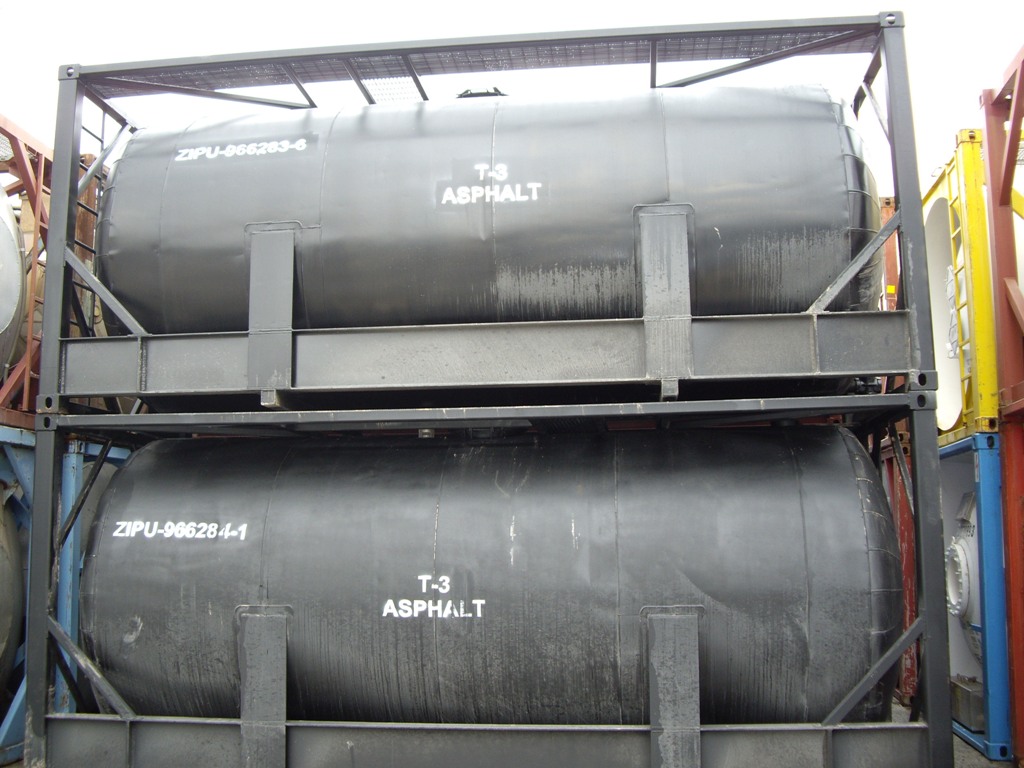
Q: What T-code are Asphalt ISO tanks built to?
A: [T3] ISO Tak Container
Design: ASME section VIII, div 1.
Material: Barrel SA-36 , Frame carbon steel
Shell: € thick
Heads: € thick
Head type: F&D
Capacity: 22,340 Liters (5901 gal)
Weight: 11,276 lbs
Accessories: Relief valve / manway / thermometer / out fire tube / in fire tube / valves included.
MAWP: 25 psig
Dimensions: 20€™-0€ long x 8€™-0€ wide x 8€™-6€ Tall
External finish: Epoxy zinc primer w/ 2€ insulation / aluminum cladding.
FOB: Houston, Texas (in depot)
Please email me for a set of full specifications:
andyd (at) tankservice (dot) com
(too much spam lately)
713-665-3001
href="http://" target="blank">www.tankservice.com
Attachments
■
Re: Where Are All The Used Iso Tanks ?
Hi all-
Thank you for all your questions...
I wanted to share with you our new blog where you can ask specific questions, leave comments...etc...
You can visit us at:
http://isotankcontainer.wordpress.com/
We also have a new blog for our static storage division.
http://storagetanks.wordpress.com/
Wishing you a great week!
Andy
www.tankservice.com ■
Imo-5 Tanks
Used IMO-5 tanks available for sale.
Follow the link to our blog...
http://isotankcontainer.wordpress.com/ ■
Re: Where Are All The Used Iso Tanks ?
Re: Where Are All The Used Iso Tanks ?
4x new T11 , 24,000 Liter tanks currently on the ground in Houston.
Email me for spec's at andyd @ tankservice. com ■
Double Compartment Iso Tank- Used
We are excited to be working on the creation of a double compartment ISO tank container. The interested part of this project is that we are taking a standard used ISO tank and peforming major surgey. This will tank will eventually finish with two internal compartents, ready to load two individual and different products.
Stay tuned to our blog to find out....
http://isotankcontainer.wordpress.com
Thanks for looking...
Andy D. ■
Used Imo7 Cryogenic Iso Tank Container Available For Sale
Dear valued customer and friend-
First of all, thank you for all the inquiries, I am always available to answer any questions regarding availability, technical, or referring you to the correct party.
Historically, Cryogenic ISO tanks IMO7 / T75 have been a rare request, simply because of their highly specialized nature. I am happy to share that we can offer you a handful of 'used' units available in Houston.
Below is a sample spec, but feel free to email me for full details:
andyd (at) tankservice (dot) com or call me at +1-713-665-3001
www.tankservice.com
ASME Code Section VIII Div. 1
• Material: SA-240 GR 304
• MAWP: 145 PSI
• Water Capacity: 5,350 Gallons/20,252 Liters
• Design Temperature:
Design Code: ANSI B.31
• Material: SA-312 GR 304
• Liquid Line/Drain: 2”
• Top Fill: 1-1/2”
• Safety/Vent: 2”
• Instruments: 3/8”
• PB: 1”
These IMO7 ISO Tank Containers are good for LOX, LIN, LAR, LNG and N2O. ■
Quote
Hi Andy,
Do you know how can I can quote 1 Iso tank of 25,000 liters capacity?
 Originally Posted by Andyde
■
Re: Where Are All The Used Iso Tanks ?
You can send me an email at andyd (at) tankservice (dot) com
Thanks !! ■
Tips For Iso Tanks
Tanker containers are also manufactured as per international standards by maintaining quality, safety and environment issues. Each hazardous chemical package has to be mentioned UN number, T code with table, tank type etc. Tank container pressure vessels are also manufactured with or with non ISO measures.
A tank container can be loaded and unloaded from the top and the bottom. On a standard tank container there is a manhole and at least one valve on the top, and there is a valve at the bottom. Loading and unloading is done by connecting hoses of the loading and unloading facility to the valves of the tank. The loading or unloading is often done using a pump. Depending on the installation and regulation of certain products, it is determined how the tank container should be loaded or unloaded.
What is the use of ISO Tanks ?
Tank containers are normally used to transport liquid products, powders and gas both hazardous and non hazardous products.
Tank containers are made of stainless steel with a protective layer of aluminum and polyurethane. The capacity of a fuel tank container varies from 27000 liters to 40000 liters. Both smaller and larger fuel tank containers are available. Approximately 4 lacks to 450000 are available at present which owns by operators and leasing companies such as Stolt Tank Containers, Hoyer, Bulk haul, Newport and VOTG etc all over world.
What are the features of an ISO Tank Container?
Most of the tank containers are manufactured as per ISO standard. The Air net Inlet valve fixed to the top of the tank and used as a pressure device during loading and a recovery device during loading. Three closure in a typically tank container protect from leakage of product. The pressure testing is done before loading to make sure about leakage and confirm all valves are operational. Pressure relief valve fitted on tank protects the tank against excess pressure or vacuum. A metal gauze fitted over the SRV(s) when carrying flammable products permits to be expelled but stops flash back. Dimensioned frames fabricated from the tensile carbon steel and comply with ISO dimension. The Data (CSC plates) shows details of tank container which includes current test data, manufacturer, weight and capacity. Document hold which is a sealed tube fixed to the frame of the tank for carriage of pertinent documents like Certificate Of Analysis, Cleaning certificate etc. Heating system makes the tanks useful for heat sensitive products. The outer skin around the shell protects the insulation from water which is called Cladding which is made of glass reinforced plastic(GRP) or aluminum. Man lid located on the top of the tank is used to enter the tank for internal inspection. Every tanker container is identified by its unique 4 alpha and 6 numerical number. The seven digit check digit is derived from formula using the tank number. The temperature gauge fitted to the rear of the tank provides an indicative reading of temperature of the product. The ladder and top walkways of a tank container makes easier and safer for access to the the top of tank container. The earth lug (ground lug) connection of a tanker container supports ground (earth) which helps at the time of loading and unloading.
Thanks,
Shri Vaibhavi Logistics ■

Where are all the used ISO tanks ?
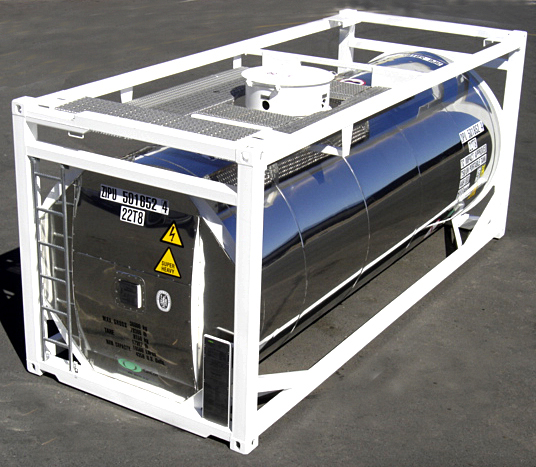
I wanted to write down a few thoughts concerning what we are currently experiencing in the industry, regarding ISO tank container availability.
This past week I was traveling back from Boston to Houston, I try to catch up on my reading when I am at 30,000 FT, when I picked up an interesting article from Newsweek discussing current US economic trends. I can only speak from this side of the pond, knowing that conditions maybe a little different in Asia and Europe, but the trend that we have seen here makes sense to me after reading this article.
In a one line summary, what we are seeing out of the US is a tremendous boom in exports in the form of commodities such as chemicals. Normally where utilization rates kept themselves checked right around the mid 80%, we have seen those rates spike to the mid 90’s. What does all this mean? Exports are creating an enormous wave of demand and every ISO tank available is being utilized to sustain customer’s demands. It is a little more complex than that; but I think you get the point.
Where in the past we have maintained large stock quantities of used ISO tank containers in our Houston terminal; the story is much different now.
This is slowly starting to swing back around but in the meantime, we have decided to replace and complement our used ISO tank inventory with new T11 (24,000 Liters) units currently on the ground for sale. We are hoping to give our customers choices, as we have always done so in the past, when a project requires immediate action.
Tip: If you find any used tanks available for sale, make sure they are certified by a world class society such as Lloyds Register, BVQI, and DNV with new 5 year test certificates available before the tanks are shipped.
For more information, feel free to email me at andyd (@) tankservice (.) com ■